
Ethiopia Counts Coffee at the Wrong End
On July 7, Prime Minister Abiy Ahmed told Parliament that Ethiopia had earned a record $3.1 billion from coffee exports. Six days later, the National Bank of Ethiopia reported that coffee export volume was down from the same period a year earlier.
Both statements can be true. That is the problem.
For a coffee-growing household in the coffee belt around Harar, in the East and West Hararghe zones of eastern Ethiopia’s Oromia region, the contradiction is not statistical. Coffee brings one concentrated seasonal income after months of work and exposure to world prices. Khat, a stimulant crop whose leaves are widely chewed in Ethiopia and neighbouring countries, can be harvested several times a year and sold into strong domestic and export markets. A national coffee record can therefore coincide with a family deciding that coffee no longer pays often enough, or reliably enough, to keep the land.
Ethiopia knows what coffee earned at the border. It does not regularly publish what growers in major coffee-producing areas such as Hararghe, Jimma, Sidama, Guji, or Yirgacheffe were paid, what it cost them to produce the crop, or whether anything remained afterward.
A record at the port is not a farm-gate account.
The blind spot extends beyond Ethiopia. The U.N. Food and Agriculture Organization estimates that up to 25 million farming households produce 80 percent of the world’s coffee. Producing countries measure exports and foreign exchange far more precisely than they measure whether those households can afford the next crop.
Higher international prices do not pass fully or evenly to producers. Inflation can absorb part of the increase before it reaches the farm. So can labour and transport costs, scarce financing, compliance expenses, and the bargaining power of everyone between the grower and the port. A rising export total matters to the national economy, but it tells us little about what remains with the producer.
Governments have built the port ledger. What they lack is the farm-gate ledger: a record of the price the farmers are actually paid where they first sell.
Ethiopia already has much of the administrative capacity needed to build one. Since 2020, the Ethiopian Coffee and Tea Authority and the central bank have operated a minimum export-price system. An export contract below the applicable minimum cannot be registered and therefore cannot ship. The schedules vary by origin and grade. A similar weekly minimum now applies to licensed domestic coffee sales made in foreign currency.
The machinery exists, but it has been used to protect export value rather than track producer income.
Ethiopia also created one of Africa’s most ambitious agricultural price-information systems through the Ethiopian Commodity Exchange, the country’s national agricultural trading platform. A peer-reviewed study found that bringing public exchange-price screens closer to rural households raised real income, with larger gains for coffee and sesame.
Coffee farmer Feleke Dukamo checks coffee-price information in Ethiopia.
But those screens showed what a lot fetched at the exchange after the coffee had left the farm. They did not show what growers in a district were paid that week or what it cost them to produce the crop. Farmers could see the market’s price, not their own.
The gap has widened as more coffee moves through direct transactions outside the exchange. More prices are set in private deals that no public screen records. Ethiopia has not lost a farm-gate ledger because it never built one.
As EU deforestation rules and other origin-verification requirements push buyers to trace coffee back to where it was grown, buyer-driven traceability is expanding. But traceability built for buyers is not the same as a public farm-gate ledger. The first gives the smallholder another obligation; the second gives the grower a reason to participate. A verified payment record can serve both purposes: documenting origin and supporting a claim when the regional price falls below a published benchmark.
The missing account matters especially because coffee is perennial. Governments can finance seedlings, nurseries, extension services, and processing equipment. They can ask growers to stump, or cut back, old trees so that they produce larger harvests later. But a rehabilitated tree produces little or nothing while it recovers, and the family still has to live through those seasons.
A household may first cut spending or sell an asset. After two or three lean seasons, shifting part of the farm to a crop that pays sooner becomes practical. In Hararghe, that crop is often khat.
A 2025 study of 788 farm households across four districts in East and West Hararghe found that 64 percent had replaced coffee with khat. Farmers described the attraction plainly: khat can be harvested more than once a year and brings quicker returns in a strong market. Coffee asks them to wait longer and carries higher labour costs.
I know this landscape. I was born in Jijiga, grew up in Chiro and Dire Dawa, and studied agricultural economics at Alemaya University. In eastern Ethiopia, the competition between coffee and khat is not abstract. It appears in decisions about what to plant and when money will next come in.
The national record does not show the change on the land. A coffee plot becomes a khat plot when the household can no longer justify waiting for one uncertain return each year.
The loss is not only the tree. Coffee knowledge travels through families: varietal selection, shade management, harvest judgment, fermentation, and drying.
Once a household leaves coffee, that knowledge does not simply reappear when prices recover.
Ethiopian regulators now appear to recognise the problem. The Coffee and Tea Authority is preparing a national Coffee Fund to cushion market shocks and finance the replanting of ageing trees. But its early description suggests that suppliers and exporters may also be compensated when international prices fall and purchases stop.
That may address a financing problem. It does not protect the smallholder who cannot wait to sell ripe coffee.
Ethiopia should build a rules-based Coffee Farmer Income Stabilisation Fund around the missing account. The government does not need a profit-and-loss statement from every farm. It needs a reliable regional farm-gate price, an estimate of what it costs a representative grower to remain in coffee, and a way to verify who sold what from which plot.
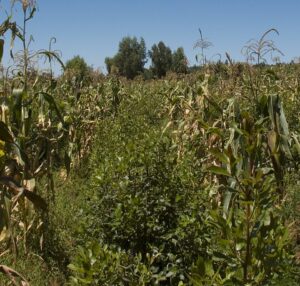
Khat growing in Ethiopia. In four districts of East and West Hararghe, 64 per cent of surveyed households had replaced coffee with khat.
Those records would support two narrow protections. One would carry a registered smallholder through the low-income period after approved stumping or replanting. The other would cover part of the gap when the regional price falls below the benchmark. Payments would stop when the trigger disappears, and claims would be limited by verified production.
This would not set a national price or guarantee a profit. Nor should it become an exporter bailout. Its purpose is temporary protection for growers, activated by a public rule.
The institution that calculates the benchmark should not also approve claims or move the money. Eligible growers should be paid directly. Payment totals and audit findings should be public. If a charge on coffee exports finances the fund, the farm-gate series should show whether buyers recover it by paying farmers less.
Ethiopia cannot afford an open-ended promise, but it can test a limited one. An illustrative two-zone, two-season model in my working paper produces a base case of about $2.6 million, roughly 0.08 percent of the reported export record. That is not a final budget. It shows that the proposal can begin small, use real data, and stop if the rules do not work.
Other African commodity producers will choose different institutions. The common test is simpler: Can the country show whether farmers are protected while trees recover, and whether the farm-gate price covers the cost of staying in production? Can someone outside government reproduce the arithmetic?
If not, the policy is not yet accountable.
International development institutions have spent decades helping African governments count what crosses a border. They should now help build the account that tells whether the producer can remain economically present.
The port ledger tells us what the world paid.
The farm-gate ledger tells us whether the people who grew it can afford to grow it again.