
The Beijing of It All: Africa’s Development Terms Are No Longer Written in Washington or Brussels
In the period that followed decolonisation, Africa’s development landscape continued to be shaped by Western partnerships. By the late 1990s and early 2000s, this Western-facing architecture took the form of policy conditionality, governance agendas and institutional reform attached to rotating credit agreements. This approach rested, at least in part, on a simple reality: countries in the Global South had limited alternatives for accessing large-scale development financing.
At the beginning of the twenty-first century, most foreign aid and investment flowing into Africa still came from Europe and North America. Explicit conditionality had become a defining feature of development cooperation, making this ‘support’ increasingly complicated for many African governments. Much of it was anchored in a Western-determined narrative of what African states ought to look like, how their economies should function and how their institutions should be governed.
Today, while the language and form of conditionality have evolved, the underlying architecture has not changed quite as much. The Bretton Woods institutions have moved away from some of the more explicit conditionality associated with the structural adjustment era. Yet financing remains tied to policy commitments, including what the IMF now calls ‘structural benchmarks’ that borrowing countries are expected to meet.
Niger provides a recent example. Following the 2023 coup, the European Union, World Bank and United States suspended assistance, with the restoration of constitutional governance a key condition for renewed engagement. Niger’s military government, however, remained in place. Conspicuously, this did not deter Chinese engagement. Amid funding suspensions and sanctions, China’s CNPC provided a $400 million advance against future oil deliveries without attaching conditions on domestic governance. This has increasingly distinguished Chinese partnerships with African governments: financing and investment largely without explicit conditions on how countries govern themselves.
Similar conditionality had followed in Mali in 2021 and Burkina Faso in 2022. In Ethiopia, following disagreement over the government’s response to the Tigray conflict, the United States removed the country from the African Growth and Opportunity Act (AGOA), citing human rights concerns. The decision reinforced the principle that its development partnerships were anchored in respect for human rights. More recently, however, U.S. support for Israel during the Gaza conflict, where Palestinian rights have been perceived by many to have been significantly affected and where tens of thousands have been killed, has raised questions about the consistency with which these principles are applied.
As Western countries have continued to hold the line on conditions attached to financing, China has found space to broaden its partnerships across Africa. In 2023, Uganda passed its Anti-Homosexuality Act, prompting the World Bank to suspend new financing. President Yoweri Museveni’s government subsequently turned to China, including for a proposed $150 million loan to advance Uganda’s digital infrastructure. Notably, in 2025, the World Bank resumed financing without the legislation having been repealed. China’s role should not be overstated, but the episode points to a changing reality: where governments have alternative sources of financing, Western conditionality may no longer carry quite the leverage it once did.
The China–Africa partnership itself is not new. Its origins can be traced to the Bandung Conference of 1955, but a significant turning point came in 2000 with the establishment of the Forum on China–Africa Cooperation (FOCAC). FOCAC provided a platform for engagement on peace and security, political dialogue, trade and development cooperation. Africa already had established relationships with the OECD, World Bank, European Union and IMF. Through FOCAC, China institutionalised its own framework for engagement with the continent.
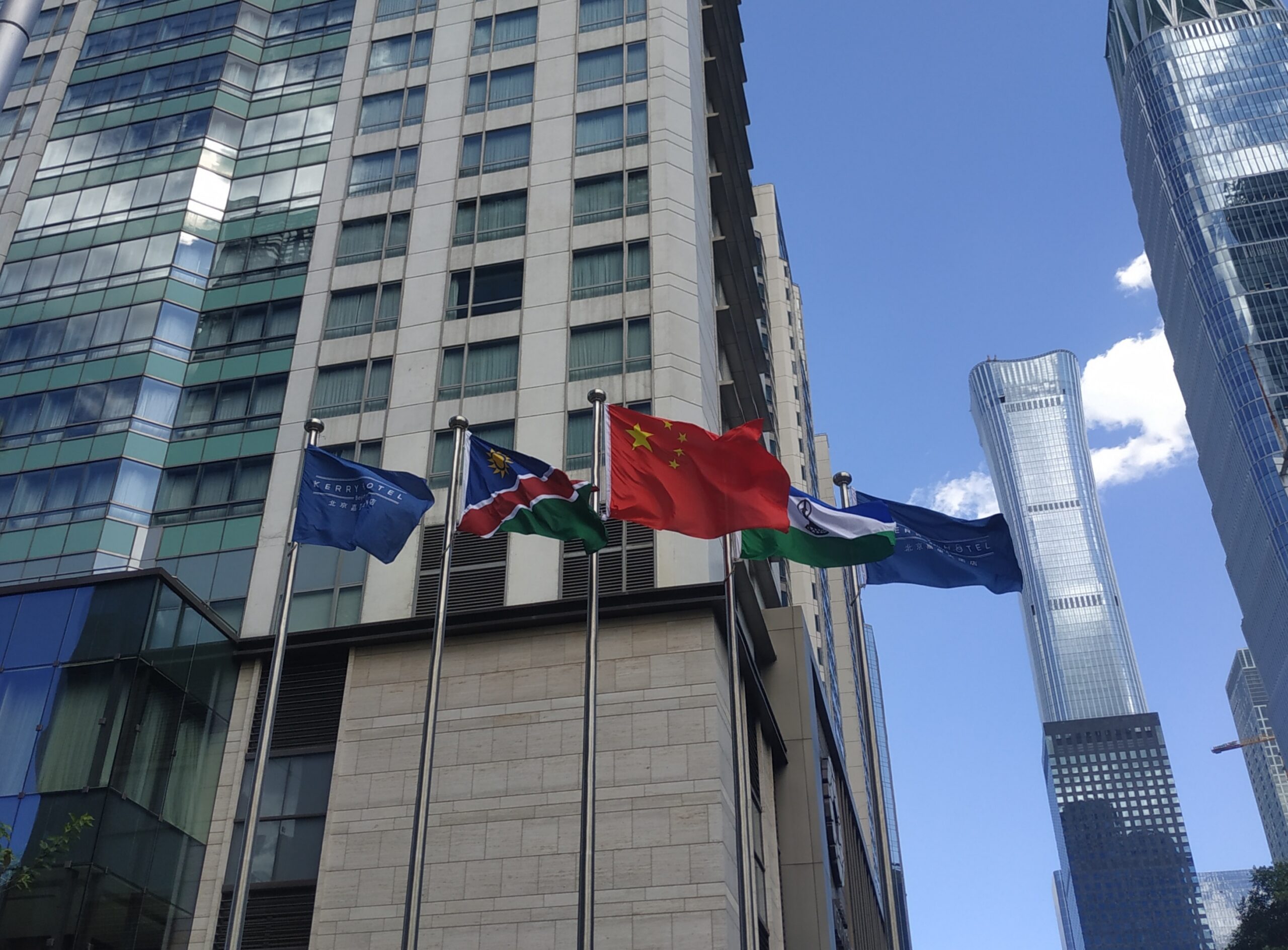
2018 FOCAC Summit in Beijing
The 2000s also marked a significant period in China’s geopolitical rise. Its economy expanded rapidly, reinforced by accession to the World Trade Organization, as Africa’s demand for infrastructure, investment and development finance grew. China had both the financial capacity and institutional mechanism to emerge as a formidable development partner.
China also approached Africa differently, framing the relationship more as one of partnership than patronage. This was informed partly by its own history of foreign encroachment. Although China was not colonised in the same manner as many African countries, unequal treaties following the Opium Wars resulted in the cession of Hong Kong, the opening of Chinese ports and significant foreign influence over its trade, infrastructure and extractive industries.
Whereas Western partnerships largely concentrated on governance, education and health reform, China brought a distinct comparative advantage in infrastructure, industrial development and digital connectivity. Two principles have consistently sat at the centre of its partnership model with Africa: non-interference and rapid delivery of development projects.
More fundamentally, China has framed Africa differently from many Western counterparts. Rather than viewing the continent primarily through the conventional development lens of poverty, dependency and perpetual aid, China has increasingly positioned Africa as a frontier of global economic growth. That distinction matters. It acknowledges Africa not merely as a recipient of development assistance, but as a strategic economic and geopolitical partner.
Africa has itself actively seeking diversified global partnerships. Its movement towards multipolar engagement did not begin with China and has long been reflected in frameworks such as the Africa–EU Partnership and the Tokyo International Conference on African Development. The suggestion that China created an entirely new development model is therefore historically incomplete. Africa had already embarked on a multipolar trajectory; China completed that landscape by becoming another major pole of partnership.
The West has consequently been compelled to adapt. For decades, Western countries largely shaped the discourse on aid and development, establishing many of the norms to which Africa and the broader Global South were expected to conform. Africa’s increasingly multipolar partnership model, with China particularly prominent, has altered that dynamic. Africa now has meaningful alternatives, and with alternatives comes greater negotiating power.
China’s engagement has evolved and is no longer as extensive as during the height of the Belt and Road era. But its influence should not be measured simply by the volume of its financing. Its greater significance may lie in the shift it helped create in the development financing landscape. China’s emergence as a credible economic partner opened an era in which African countries could increasingly redefine their terms of engagement through broader economic relationships.
The West remains enormously influential, but it no longer unilaterally defines what constitutes development, acceptable parameters of institutional and governance reform, or priorities underpinning international cooperation. This shift cannot be attributed to China alone, nor can changes in Western approaches to conditionality. But credible alternatives have undoubtedly contributed. After all, conditionality derives much of its leverage from the recipient’s lack of choice. As economist William Easterly argues in The White Man’s Burden, development succeeds when local institutions, incentives and accountability drive reform—not when outsiders attempt to engineer it.
Ultimately, the focus should not be on whether China can completely replace Western partnerships in Africa’s financing landscape. Rather, it should be on the mark China–Africa partnerships have left on that landscape. They have demonstrated that when countries in the Global South have alternative economic relationships, they can substantially renegotiate the terms of engagement they have sought to challenge for decades.