What South Sudan’s mothers teach us about political authority
South Sudan is approaching a critical moment in its political transition. Elections are scheduled for December 2026, while questions around constitutional reform, political inclusion and the faltering implementation of the 2018 peace agreementcontinue to shape debate about the country’s future. As South Sudan considers what legitimate and accountable governance might look like, the experience of a group of mothers and grandmothers in its eastern borderlands offers another place to look for political authority.
‘If you want to kill each other, you must kill us first.’
These were the words of a Murle grandmother describing the message that mothers and grandmothers carried into their communities across Greater Pibor in 2017. Their sons and grandsons were caught in escalating cycles of violence between competing youth age-sets — socially recognised generations of young men. The women responded by deploying not weapons, but their voices and bodies: through song, dance, public shaming and, ultimately, the threat of maternal nudity.
Years of conflict and militarisation have transformed relations between generations. Cattle-raiding, revenge killings and child abductions have intensified and become increasingly brutal. Chiefs and elders continue to play important roles, but the scale and intensity of violence demanded new forms of collective action.
The women formed the Kabarze — translated as ‘the virgins’ or ‘unmarried girls’ — an evocative name for a movement composed largely of mothers and grandmothers. The name echoed songs and dances traditionally associated with young unmarried women, which the Kabarze drew upon as they confronted violence. As one woman explained: ‘We formed the Kabarze so our children would survive all this fighting. Boys weren’t listening to the old men […] so we formed our group. If they are to beat us, they’ll know we carried them for nine months and gave birth to them.’
Beginning organically in one locality, the movement spread across Greater Pibor as women in other villages established their own Kabarze groups. Moving collectively between the homesteads of armed youth, they sang, danced and confronted those involved in fighting. Their songs identified those responsible for violence, invited reconciliation and exposed responsibility to public scrutiny. Their performances interrupted attacks, demanded cattle compensation and compelled young men to surrender weapons. When necessary, the women invoked the powerful moral force of maternal nudity, a practice that carried profound significance within Murle society, as in other African contexts.
The Kabarze drew their authority from motherhood, kinship, collective responsibility and cultural forms of intervention that young men and the wider community already recognised. Their story offers an important lesson about governance itself: where political authority comes from, how it is communicated, and what this could mean for the future of governance and peacebuilding in South Sudan.
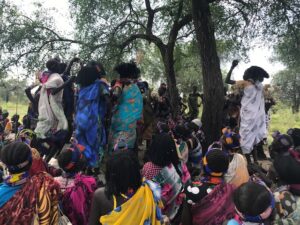
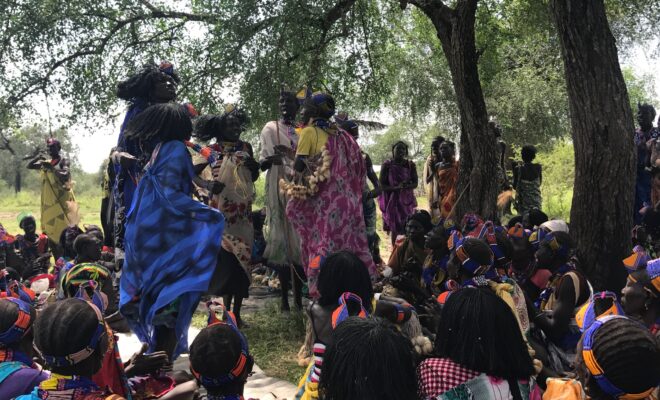
Kabarze women performing in Manyirany Payam, Pibor, in October 2017, the year the movement first emerged. Photographs by Diana Felix da Costa.
Where does political authority come from?
South Sudan’s political future continues to be imagined through debates about constitutional reform, elections, political inclusion and the implementation of peace agreements. These remain central to both South Sudanese political debate and international engagement. Communities, however, experience governance through a much broader and tangible landscape of authority. Across South Sudan chiefs, elders, churches, spiritual authorities, kinship networks, clans and sections, age-set hierarchies, youth leaders and women’s collectives all shape social life. Their legitimacy and influence stem from long-standing social and spiritual relationships and shared understandings of responsibility, obligation and belonging.
For the Kabarze, motherhood connected women to the young men engaged in violence. Acting collectively through shared repertoires of song and dance gave that relationship public and political force their sons and communities understood.
Song is central to how women communicate that authority. As one elder woman explained: ‘We women don’t have rii and so to express what we have in mind, we sing.’[3] Rii are communal spaces where men gather to discuss public affairs. Through song, women articulate grievances, name responsibility, shape public opinion and intervene in collective life through a form their communities immediately understood. Collective performance amplifies that authority. ‘When we come together we sing and dance and we think of our sons from Lanngo and Kurenen, and we stop the fighting between them,’ one Kabarze woman explained.
A wider repertoire of governance
The experience of the Kabarze encourages a richer understanding of governance. Governance grows wherever people possess the authority to influence behaviour, mobilise collective action and restore accountability. Formal institutions contribute to that process. Cultural practices, moral authority and embodied forms of communication contribute as well. Together they create the political repertoires through which communities organise everyday life.
Songs are a means of public accountability; performance a space for confrontation and negotiation. The Kabarze deployed these alongside the maternal body, itself a source of political legitimacy. As explained by one woman:
‘If they don’t stop fighting, we’ll take all our clothes off so they fear us and run away. (…) Our breasts are the ones to stop these things, and removing our clothes makes them listen to us. If they need to die, we will die with them. If they don’t want to listen to us, let us die with them.’
These practices carried political force because they shaped decisions, interrupted violence and strengthened collective responsibility. They were forms of governance because communities recognised their authority and responded to them. Recognising song, performance and the body as forms of political communication expands what we see as governance — and who we recognise as political actors.
The lesson travels well beyond Greater Pibor. Across South Sudan and elsewhere in Africa, political life is communicated through multiple forms whose meanings are rooted in particular histories and social worlds. Paying attention to these repertoires can reveal forms of authority that conventional meetings, consultations and governance assessments may struggle to capture.
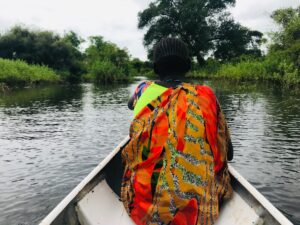
A woman crossing the Pibor River during the rainy season, September 2019. Photograph by Diana Felix da Costa.
Can support change legitimacy?
For peacebuilders, the experience of the Kabarze points to the importance of a wider practice of ‘deep listening’: one attentive to song, movement, performance and the body, and to the political work these forms of communication perform. Recognising these repertoires can reveal forms of authority already grounded in relationships of legitimacy, responsibility and trust. It also raises a critical question: what happens to legitimacy when support changes the relationships that produce it?
The growing emphasis on locally-led peacebuilding has encouraged governments, NGOs and international agencies to identify successful community initiatives and bring them into programmes, partnerships and funding mechanisms. Partnerships can expand reach and visibility, while project structures, allowances, reporting requirements and organisational representation introduce new relationships of accountability.
Legitimacy, however, grows through social relationships. It cannot simply be transferred into new institutional settings without changing the conditions that give it authority. For the Kabarze, their influence grew through motherhood, kinship, collective performance and moral responsibility. Young men listened because these women spoke as mothers and elders within relationships that carried deep social legitimacy. As the Kabarze became associated with government and NGOs, they lost much of the moral and political authority they held in the eyes of their sons, as young men increasingly understood these women as representatives of organisations rather than representatives of the community.
Their experience suggests that effective engagement begins with understanding how authority works within a particular social world: where legitimacy comes from, how it is communicated and which relationships sustain it. Funding and institutional recognition can create valuable opportunities. Careful observation and restraint can give existing forms of authority space to operate through the relationships that make them effective.
Nearly a decade after the Kabarze first mobilised, the question of what legitimate and accountable governance looks like remains as critical as ever in South Sudan. Political agreements, constitutional reform and public institutions will inevitably shape that future. Yet across vast rural and borderland areas where the state has a limited presence, governance also takes shape through the relationships through which people negotiate responsibility, authority and peace in everyday life.
One woman put the source of their authority simply: ‘Everyone walking here on earth came out of a woman and for that they must listen to a woman’.
The Kabarze turned that relationship into collective political action. Their experience invites us to pay closer attention to where political authority already lives, how people communicate it, and the relationships through which peace is made and sustained.
This work is supported by the Cross-Border Conflict Evidence, Policy and Trends (XCEPT) research programme (300100), funded by UK International Development. The views and opinions expressed are those of the author(s) and do not necessarily represent those of the UK government.